

康熙王朝


分类: 求婚大作战
今夜有戏
WATCH: Jonas Brothers Return for Camp Rock 3, Fans Ask About Demi Lovato_我的网站

A | The Jonas Brothers have returned with a new teaser for Camp Rock 3, setting internet ablaze. While Demi Lovato wasn't visible in the video, her voice was heard in the background many a time. Still, fans have been wondering whether she would make a comeback with this threequel. While Lovato is not included in the cast list, her character Mitchie Torres' voice is heard time and again. She can be heard in a voiceover featuring lines from the first two Camp Rock movies, along with her duet with her onscreen love interest Shane (Joe Jonas), Wouldn’t Change a Thing. The montage also includes shots of Mitchie’s journal, where she had written all of her songs.Maria Canals-Barrera, who plays Mitchie's mother in the movies, is also returning. Fans have been excitedly discussing whether the signs actually lead to Lovato's cameo or full-fledged role in the third film.In the trailer, the Jonas Brothers reminisce the good, old days. "Music, friendship, memories," Nate (Nick Jonas) says. "We're back, exactly where we're supposed to be," Shane adds. "Still no birdhouse," Jason (Kevin Jonas) hilariously shares.While the official release date hasn't been shared, the makers have announced that it will be released in Summer 2026. The teaser was shared on social media with the note, "The memories, music, and good times are back, and so are Kevin, Joe, and Nick, for the can't-miss summer event Camp Rock 3! Welcome back to Camp Rock, as a new generation of campers find their voice. Starring Joe Jonas, Nick Jonas, Kevin Jonas, and welcoming new campers: Liamani Segura, Malachi Barton, Lumi Pollack, Hudson Stone, and Casey Trotter. Pack your bags and get ready to rock out for a summer you won't forget!" The new cast members were shown in the teaser. The movie is slated to arrive in Disney+ and Disney Channel. Also Read: Priyanka Chopra Jonas Can’t Contain Her Happiness on Seeing Nick Jonas in These Clicks。
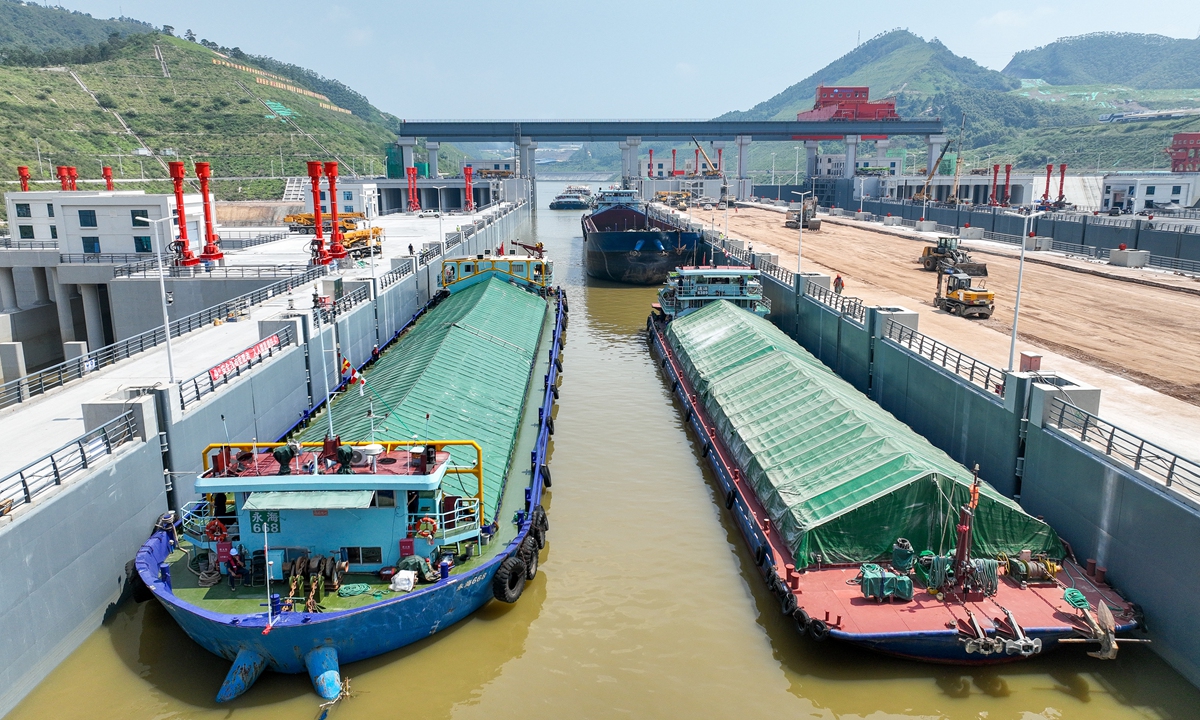
Equipped with China's homegrown BeiDou positioning systems, drones and sensors, four vessels began trial runs along China's Pinglu Canal on Wednesday. The canal, which is planned for opening in September, will greatly inject economic vitality to areas along its route and turbocharge China's trade connection with the ASEAN with its cost-saving transportation, a Chinese analyst said.
The vessels conducting trials on Wednesday represent the main types expected to sail on this canal, namely loaded and unloaded 5,000-tonne ships as well as loaded 3,000-tonne and 1,000-tonne vessels, Xinhua News Agency reported.
The trials began when an unloaded 5,000-ton vessel departed from the Xinfu service area along the canal in South China's Guangxi Zhuang Autonomous Region, the Xinhua News Agency reported.
With sensors collect data on their routes, movements, water currents and safe distances between ships, the tests will assess navigation under both normal and adverse conditions and examine whether the canal's waterways, locks, anchorages, service areas and navigation facilities are ready for operation.
Chinese analysts said the tests starting on Wednesday, days after the canal completed its first full-route patrol, indicated that the canal is one step closer to its scheduled opening in September as final preparation work ramp up.
Zheng Ping, chief analyst at industry news portal chineseport.cn, told the Global Times on Wednesday that as a major project in the nation's water network, the opening of the canal later this year will bring sea changes to areas along its route with fresh economic opportunities with its role as a low-cost enabler for domestic and international trade.
"Inland water traffic has great advantage in transportation capacity and costs. While a train can typically carry 20 40-foot container or more, a waterborne vessel can easily carry over 100 such containers. So a five-times capacity is gained here, greatly reducing transportation costs for goods," Zheng said.
For goods that are not time sensitive, or for bulk cargo such as coal, aluminum or fertilizers, waterborne traffic has unparallel advantage, the expert noted.
The 134.2-kilometer-long Pinglu Canal is a key project of the New International Land-Sea Trade Corridor. With total investment exceeding 70 billion yuan ($10.37 billion), the canal begins at the Pingtang River estuary in Hengzhou, administered by Nanning, follows the Qinjiang River into the Beibu Gulf, according to Xinhua News Agency.
It is China's first major river-to-sea canal project planned and coordinated at the national level since 1949 and is designed to accommodate vessels of up to 5,000 tons.
In addition to facilitating transportation, modern canal system will also have the function of water resource diversion, flood control and irrigation, greatly boosting up local economic development, Zheng said.
Lei Xiaohua, deputy director of the Institute of Southeast Asian Studies at the Guangxi Academy of Social Sciences in South China's Guangxi Zhuang Autonomous Region, told the Global Times on Wednesday that the Pinglu Canal will serve as a new engine for the deep integration of industrial chains between China and ASEAN.
"Raw materials from ASEAN can enter China's hinterland via the Beibu Gulf ports at lower costs, while Chinese exports including aluminum products and building materials can reach Southeast Asia more efficiently," Lei said.
Against the backdrop of deep industrial chain integration between China and Vietnam, the canal, which offers a low-cost, high-capacity transport route, is poised to foster new models of cross-border industrial capacity cooperation, said Lei.
When operational in September, the canal will give inland regions in Southwest China a more direct river route to the sea. Cargo that previously had to travel eastward through the Port of Guangzhou will be able to head south directly toward ports in the Beibu Gulf, shortening some inland waterway journeys by about 560 kilometers, according to Xinhua.
The New International Land-Sea Trade Corridor is an international trade and logistics network connecting China's western regions to ASEAN countries and other overseas markets.
The corridor has continued to record strong trade growth. During the first half of 2026, imports and exports transported through the corridor by its participating regions reached 517.23 billion yuan, up 13 percent year-on-year and setting a new record for the same period, per data released by Chongqing municipal government.
The corridor's rail service handled a record 1.425 million 20-foot equivalent units of cargo in 2025, up 47.6 percent year-on-year. As of early June of 2026, its network reached 593 ports in 128 countries and regions.
。
Current article:http://o62.seruilushuishamie.bond/news/20260826_1713703.html
Published on:05:25:13
下一篇:优地机器人通过港交所上市聆讯
- 深圳瑞捷:半导体洁净室业务尚处市场拓展期 收入占比较低
- 台风“紫檀”持续影响华南沿海 北方多地清凉上线
- 直播助力村民每天卖果5000斤
- 新一轮国补官宣继续!国补政策2026年最新消息:第三批625亿国补申领中!买手机平板电脑3C数码国补15%叠加京东开学季校园教育优惠活动,学生换新时机到了!
- Bidens' Scheming: Why 'Laptop From Hell' Exposure Irks the Dems More Than It Does the GOP


